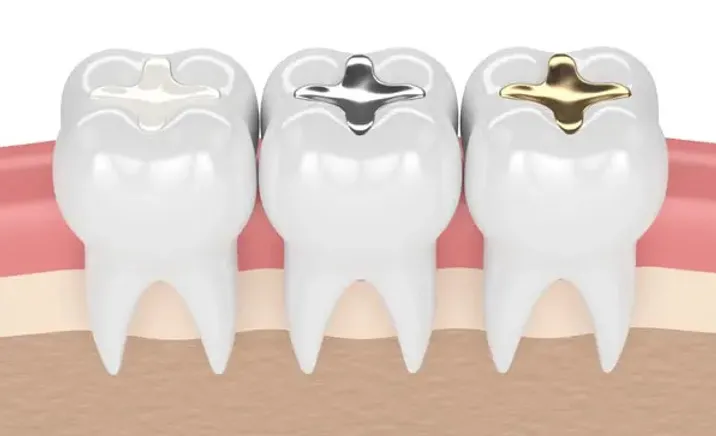
Dental restoration, dental fillings, or simply fillings, are treatments used to restore the function, integrity, and morphology of missing tooth structure resulting from caries or external trauma. The process of preparation usually involves cutting the tooth with a rotary dental handpiece and dental burrs or a dental laser to make space for the planned restorative materials and to remove any dental decay or portions of the tooth that are structurally unsound.
Direct restorations: This technique involves placing a soft or malleable filling into the prepared tooth and building up the tooth. The material is then set hard and the tooth is restored. The advantage of direct restorations is that they usually set quickly and can be placed in a single procedure.
ndirect restorations: In this technique the restoration is fabricated outside of the mouth using the dental impressions of the prepared tooth. Common indirect restorations include inlays and onlays, crowns, bridges, and veneers. These procedures require multiple visits.
Materials used:
-
Amalgam:Amalgams are alloys formed by a reaction between two or more metals, one of which is mercury. It is a hard restorative material and is silvery-grey in colour. One of the oldest direct restorative materials still in use, dental amalgam was widely used in the past with a high degree of success, although recently its popularity has declined due to a number of reasons, including the development of alternative bonded restorative materials, increase in demand for more aesthetic restorations and public perceptions concerning the potential health risks of the material.
-
Composite resin: Dental composites, commonly described to patients as "white fillings", are a group of restorative materials used in dentistry. They can be used in direct restorations to fill in the cavities created by dental caries and trauma.
-
Porcelain (ceramics): Full-porcelain dental materials include dental porcelain (porcelain meaning a high-firing-temperature ceramic), other ceramics, sintered-glass materials, and glass-ceramics as indirect fillings and crowns or metal-free "jacket crowns". They are also used as inlays, onlays, and aesthetic veneers.
-
Porcelain (ceramics): Full-porcelain dental materials include dental porcelain (porcelain meaning a high-firing-temperature ceramic), other ceramics, sintered-glass materials, and glass-ceramics as indirect fillings and crowns or metal-free "jacket crowns". They are also used as inlays, onlays, and aesthetic veneers.